Friday, May 17, 2013

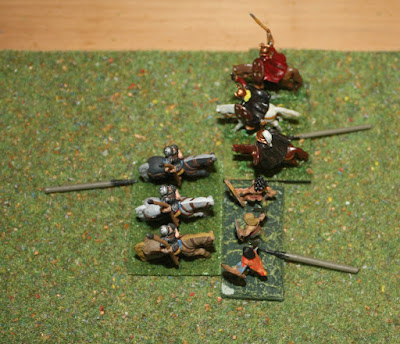
Battle of Acragas 406BC using Ancient Battlelines Clash

Introduction
This is game 8 in playtesting my ancient rules. Previous games used my rules called Ancient Warrior  Battles.  After game 6 I streamlined them and simplified the combat mechanism so renamed them Ancient Battlelines Clash (ABC).  The latest version is on its own blog page. I am playtesting the rules by replaying all the Peter Sides scenarios from his Historical Battles books.  ABC is designed to finish in under an hour on 2'x2' tables.

Battle of Acragas

During the Peleponnesian War in 410, Carthage came to the aid of some Sicilian cities. In 407BC, Syracuse and Acragas aggravated the Carthaginians who laid siege to Acragas in 406.  A Syracusan lead relief party failed to dislodge the besiegers possibly, some say, because Acragas failed to sally out to help. This battle represents the relief party trying to dislodge the Carthaginians (which they did on the eastern side as portrayed here, but there was more of the army on the other side of the city).

Here are links of interest:

Wikipedia article
Diodorus account in Book 13 (see 86-87)

Changes to the Bill Banks Scenario
The scenario is designed to play on a 35"x28" board.  I reduced the forces by about a third to play on a 24"x24" board. I did halve the hoplites for both sides - the deployment map infers a second rank of spears for each side.  This infers a bonus in DBA but not in my rules so I left them out.


Troops
Early Carthaginian


3 Libyan Spearmen, HI, missile protection 0, phalanx
2 Chariot, HCH
2 Heavy Cavalry, HC
4 Light Infantry, LI
2 Skirmisher, SI, javelin
1 +1 General

Breakpoint: 9

Syracusan


3 Hoplites, HI, missile protection 0, phalanx
2 Hoplites, HI, missile protection 0, phalanx, low fortitude
2 Heavy Cavalry, HC
6 Light Infantry, LI
3 Skirmisher, SI, javelin
3 Skirmisher, SI, bow
1 General

Breakpoint:10

Deployment
Deployment:

Deployment, Carthaginians at the top between the two ramparts.  Hill represents the city.
 Note that the city walls are impassable, and the ditch is classed in DBA terms as difficult going.  Difficult going has quite an impact on combat effectiveness in DBA. In my rules, difficult going (rough) is really really bad e.g. cavalry cannot cross, so I will make it a hill (like a steep hill in Armati). This will halve movement for heavy and mounted units and also reduces the combat value of most cavalry and heavy infantry.

The Game
Syracusans move first. The lights of the flanks move to a position on the rampart, the hoplites move up in the centre and the left flank heavy cavalry fails to move (failed the order roll).  The Syracusan plan is to harass the flanks with the light stuff (backed up by the cavalry), and hopefully win on one or two of the flanks and use that flank to assist in the centre. The Carthaginians responded by attacking the flanks with the light infantry - otherwise they are going to sit there and take missile fire.

On the left flank, the Carthaginian LI managed to raise the ire of an opposing LI that repeatedly followed up combat.  The retreating Carthaginian LI finally routed when interpenetrating the cavalry (disordering them).  The Syracusan LI stopped just in front.

LI breaks thorugh on left.  Green markers are disorders.  The Carthaginian subgeneral is the two hoplites behind some LI.
The Syracusan right flank fares no better - the Syracusan skirmishers are swept away, but the remaining light infantry becomes a bit chaotic and mostly disrodered, Carthaginians coming off worst.

The Syracusan right flank (Syracuse on the left)

Continuing on the same flank, Syracusan LI against a Carthaginian chariot -anything but a 6 will cause the LI to retreat.  Rolled a 6 and both disordered and remain in melee.  This means the Heavy Chariot will not get a +2 charge bonus next turn.

Syracusan LI in combat with a Carthaginian Heavy chariot.  Lucky rolls see both disordered.

Syracusan hoplites cross the rampart.


The Syracusan hoplite line crosses the rampart but are not quite in contact.  The low fortitude hoplites are on the Syracusan flanks.
One of the LI turns 90 degrees to flank a poor Syracusan hoplite.  Movement in the rules is restrictive for HI but LI can wheel 90 and move.  But the LI rolled badly for melee and were routed as they were already disordered.  Worth a shot.

LI wheels onto the flank of a Syracusan hoplite but ends badly for the LI( it routs).

Syracusan Hoplites move into melee with Carthaginian hoplites. All hoplites in contact disordered. Bit of a bet to make a difference - while the Carthaginian flanks are being held by the LI, one the LI are gone, there Carthaginian's have the advantage of number son both flanks (2 heavy mounted Vs 1 on each flank).  But only so long the LI will hold.

Syracusan Cavalry charges opposing cavalry (it is disordered from previous brush with  a LI), but all that results is a disorder.

Syracusan Heavy Cavalry (bottom right) charges the opposing Carthaginian Heavy Cavalry (top right) while the chariot is engaged with a LI.
But the Heavy Chariot next to it routs the LI, pursues into the Cavalry but no effect.  Chariots will almost always pursue.

...but the LI routs, chariots advances into the heavy cavalry but the results sees them locked in melee.

Just about  every unit on the board is disordered!

Note about difficult going - makes the LI pretty tough as the Cavalry don't get a +2 shock bonus, and are also are at -2, so the LI have a very large advantage.  And no heavy units lost yet either.

Moved the sub-general over the the Heavy chariot and Heavy Cavalry and finally managed to destroy a heavy unit - the Syracusan Heavy cavalry.  The Syracusan left flank has gone.


The Syracusan left flank has collapsed - there is only one LI left on the rampart but the Carthaginians have two heavy mounted units that can just go around it.
Hoplite clash in the centre sees two Syracusans gone and one Carthaginian.  Low and high rolls!

What is left in the centre after a round of hoplite combat.  Both generals involved, but both survived leader death checks.

..and on a lucky roll of a 6, the Heavy Chariot destroys the Syracusan LI.  Syracusan has reached breakpoint of 10 and so the Carthaginians win.  A bloody victory.

The Syracusan LI to the lower right, just before it is routed in combat with the Chariot.

End game:

At the end, Syracusan forces to the bottom. 

Verdict
An interesting battle.  While this one was finally decided in the centre, the flanks were vey important.  The Syracusans should win the centre with more hoplites but the flanks see them with more lights troops than the Carthaginians, but outnumbered in heavy troops.  This is what saw the Syracusans off in the end - the heavier flank units of the Carthaginians.

This game took a long time to play.  It did not help that I stopped playing it for about 8 weeks after the second turn.   Even then with the action on the flanks before the centre decided the battle, it was likely a hour to play - longer than I would have liked.  There was a lot of points of troops of the table - about 50% more than what would be a 'normal' game of ABC.   But it was interesting.  I thought the Syracusans would get slaughtered but they put up a really good fight and the game could have swung their way at any time.

Saturday, May 11, 2013

Battlegroup Kursk (BGK) first game and thoughts

Andy and I played our first game of Battlegroup Kursk (BGK) at the club in mid-April.  We both got the rules in December last year but this was the first opportunity to play it.  It was also the first time I had been at the local club since 1995 playing DBM, and the first time since, I think, 2005 that I have played a WW2 game face to face.  I am hoping that the time between trips to the club and face to face games gets shorter in the future!

It has taken a while to post this as I have been short of time to prioritise to gaming in the last month.
I will start by saying what I think of BGK and then a short description of the game.  I was too busy playing to take too many pictures!

Verdict on the rules
Are they good? Yes and no. No in that they are not THAT good. they are good, but did not set my world on fire.  But yes: it was an enjoyable game, I had fun, I think the rules are good at recreating what they are trying to portray and would more than happily play again.  Note that I do not think there is a perfect set of WW2 rules for me anywhere, including ones I have written, so it is unlikely any rules are going to get a pure yes anyway!  And it was an intro game on a same table so did not get the full impact of playing either, so I believe my opinion will go upwards when playing on a larger table.

We played on a small table (6'x4') and I can see it would shine on a 8'x6'. As the table was small and even though we only used a few forces, the depth meant there was not a lot of manoeuvre so the game was a line them up and go. And that was also as a result of poor tactics and focussing on trying to capture two objectives when concentration on one would have been a lot better.

It does play well, the mechanisms are well thought out and fairly smooth (although artillery fire has lots of steps and it was a little tedious for our first outing with it) and there was lots of book flicking for the first few hours. You are often throwing 7-10 dice for hits and I am not a bucket of dice person. The game does have the feeling of ww2 as units are pinned and it is trying to unpin them to move them into position to fire back before getting pinned again.

My only quibble on mechanics is that BGK has a unit choosing between Aimed fire (focussing on casualties) and pinning fire (focussing on preventing enemy actions). While I like the fact that casualties is differentiated from action limitations, I like to have them both rolled into one so that a unit does not have to chose (i.e. a unit fires and the result may be casualties, or pinning, or both). I prefer to think troops just fired for suppression/pinning and casualties were a bonus.

In summary, jury still out. I like it, do not love it (yet, but may never do). Need a few more bigger games to see how good it is . Again, the mechanisms are sound and the feeling it there. Is it worth the expense? Don't know but I am a rules junkie and the book is beautiful and the army lists are very extensive.

The game overview
We played the introductory scenario on page 170 on a 6'x4' table. Basically an engagement scenario with a  platoon of infantry, some armoured scouts and a tank each.  We were sparse with the terrain, just laying out the pieces as per the scenario map and using the painted game board  as a base.  We just wanted to get stuck in to learn.  The good news is that you do not seem to need as much terrain as in some other WW2 games.  Of course, more terrain always looks good.

I was the Russians with Andy the Germans.  As the Germans are outscouted in this scenario, the Germans have to pick out a battle counter.

Me: "I hope it is not an aircraft chit.  I haven't looked at the aircraft rules at all.  Have you?"
Andy: "Not really. By the way, if it is an aircraft chit, when do I show you?"
Me: "I think you would show me after we deploy and it takes effect next turn, which would be the first turn."

So, after deployment Andy shows me the Aircraft counter.  I think it took an hour to go through to resolution as we had never read them and you also need to go through the artillery rules (which both of us have only skimmed also!), which for the first time is interesting.  But this really helped...because the second counter that Andy was forced to draw was....an aircraft!  This went a lot faster to resolve.

View of the board from one side after deploying scouts.  Russians on the left - BA-64 on the road; Germans to the left - a destroyed halftrack near the junction.  The red marker is an objective, but also very near the point of attack for the German aircraft bombs.
 After deployment of scout forces, The German halftracks were in sight of my BA-64 and T-70.  Russians win the initiative and two actions later, the Germans have lost their scout forces.  That was quick and unexpected.  Good in that it was easy to perform.  And now we know a bit more about how the rules work and initiative being important.
 

My T-70 that managed to control my left flank for a few turns, until destroyed a German reinforcement - a Panzer IV.
 We found we did a lot of firing to pin during the first 5 or so turns.

The view of most of the Russian infantry forces from the German end of the table. 

Another view of the forces but slightly to the left, just to give an idea where they are. The hill and the woods really put a stop to trying to press the advantage.
 
Neither of us had sufficient forces in a particular place to strike forward, and after unpinning, they just got pinned again.

A shot form the Russian side of two units =on ein the woods and one near the hill.  The one near the hill is pinned, the one in woods is about to be.


And this is what caused the pinning of the troops in the woods.  The PanzerIV came in on the right flank and promptly took out the only Russian armour - a T-34 and T-70, then pinned a unit of infantry on the the German right flank before turning towards the centre.


But then looking over the rules, I can see than  for aimed fire, scoring a casualty will result in a morale test that has a 1 in 3 chance of pinning most units.  So I started aimed fire to good effect.  But then so did Andy start using aimed fire with the Germans to good effect as well.  Eventually I went over my battle rating and lost the game.  I think all my units were pinned by this stage and Andy have about half of his pinned.  Neither of us had lost an infantry unit.  It was a game of attrition due to the terrain and limited board size, and I think Andy played the attrition game better than me, but only after I knocked out all his half-tracks on turn 1!


Sunday, March 31, 2013

Battle of Plataea 479BC using Ancient Battlelines Clash

Introduction
This is game 7 in playtesting my ancient rules. Previous games used my rules called Ancient Warrior  Battles.  After game 6 I streamlined them and simplified the combat mechanism so renamed them Ancient Battlelines Clash (ABC).  The latest version is on its own blog page. I am playtesting the rules by replaying all the Peter Sides scenarios from his Historical Battles books.  ABC is designed to finish in under an hour on 2'x2' tables.

Battle of Plataea
After the invasion of Greece by Persia in 480, The Persians had their successes, but lost the naval battle of Salamis.  Xerxes left some of his army with Mardonius to continue the war.  The Greeks responded with an alliance of city states and won a victory over the invaders.  Mardonius was killed, much of the Persian army also killed and the remaining Persians left Greece.

Here are links of interest:

Wikipedia article
SOA Battle Day 2012 pics (Slingshot 283 has a lot of info that I referred to)
Caliban's Plataea scenario
DBA Scenario
Military History Online description
Livius.org summary (Herodotus 9.1-89)

Changes to the Bill Banks Scenario
The scenario is designed to play on a 77"x55" board.  I reduced the forces by about two-thirds to play on a 24"x24" board.  The depth ratio will be fine being longer as ABC has longer move distances than DBA.  The scenario also had lots of contours that I simplified based on Lost Battles and the SOA Battle Day 2012 replays.  The number of units and their deployment changed a little, mostly to differentiate troop types e.g. all the Hoplites were treated the same, I made the Spartans better.

Sides also recommends 2 generals for each side with each extra general adding 1 to the roll for PIPs.  I did not increase the general status, or add subgenerals, as I have only one-third of the troops and table width as the Sides scenario. 


Troops
Greece
2 Spartan Hoplites, HI, protection 0, phalanx, fortitude +1
6 Hoplites, HI, protection 0, phalanx
4 Skirmisher, SI, javelin
1 General

Breakpoint:8

Persia
Persians
2 Immortals, HA, bow, fortitude +1
4 Median Infantry, HA, bow 
2 Subject Infantry, LI, bow
1  Heavy Cavalry, H, bow
1 Light Cavalry, LC, bow
Medising Greeks
2 Hoplites, HI, protection 0, phalanx
1 Skirmisher, SI, javelin
1 Heavy Cavalry, HC, fortitude -1
1 Light Cavalry, LC, javelin

1 General

Breakpoint:12 

Note: HC have bow. When I originally played the scenario, I did not have them with  bows but they should have.

Deployment
Deployment:

Deployment


Persian General is with the group on the hill, as per scenario setup (not like the picutre above where he is in the middle of the board - I moved him after the picture was taken)

I always use my optional rules on deployment for these rules. A side may only setup 3 controlled groups (4  controlled groups if a +1 general, 5 controlled groups if a +2 general).  Any other groups at deployment are uncontrolled (similar to uncontrolled in Armati).  If a general stays with an uncontrolled group for an entire turn, it has a 50% chance of becoming controlled.

The Game
Persians move first and the two wings of the force are already hampered being more than 20cm from the general (-1 to orders).   Not much happening in first few turns.Then the Spartans and comrades on the Greek left flank charge into close range of the Persian cavalry that need to take a Zone of Control test.

Spartans and Persian Cavalry in close combat (on right)

Light cavalry evades, Persian heavy cavalry routed (which is what you would expect when you charge a Spartan phalanx frontally). I like this bit - heavy cavalry may be forced to charge units they don't really want to.  They do have a 1 on 6 chance of disordering the hoplites, otherwise they will rout.

Heavy Cavalry routed by Spartans (on the right).  On the left, the Immortals and Sparabara are coming over the hill.

The Athenian right still fails to move (failed the move order).  The uncontrolled Persian group at the centre rear remains uncontrolled. The general has to roll a 4 or more on a d6 to make them controlled and they can move.  They did not do this for the whole game of 4 turns.  I like the idea of uncontrolled groups (borrowed from Armati).

The reserve group on the hill.  They never entered the battle.


LC harasses the Spartans, draws them out but are routed without inflicting any damage. Hoplites are well shielded and only a 1 on a d6 will inflict damage form missiles on a hoplite.

Immortals and some other Sparabara come over the hill and get close to the Tegean hoplites that charge.  Persians fire back for no effect.  The following combat sees just about everybody disordered.  Disordering hoplites is bad for them.  Normally they have a combat rating of 5, and Sparabara 3. But a disordered hoplite is a 2, as is a disordered sparabara. So if the sparabara can disorder the hoplites through shooting, or survive the first round of combat, the subsequent rounds are fairly equal.

Right flank hoplites and Immortals in combat
Athenians finally move and cause the Medising Greek hoplites to charge. The ensuing combat sees a Medising Greek unit rout.

Medising Greeks.  From left to right: light cavalry, heavy cavalry, hoplites.

The Spartans on on the flank of the Sparabara and Immortals and roll up three units via the flank before running into their own troops.  Flanking is bad.  And if you pursue and contact another unit, you can melee again.

Right flank owns the hill.  The last remaining Sparabara is on the far left.

Medising cavalry charges the hoplites but bounces back; the following turn sees the last Medising hoplite flanked and is routed.

The left flank - all the Greek Hoplites survive.  Only the Medising Light and Heavy Cavalry (top left) are left.
 Persian breakpoint is reached and game is over for a Greek win.

Verdict
It is been four months since I last played my rules, and since then I have streamlined the combat rules and aligned all the other mechanisms to that.  It was a minor change but a really good one as it really streamlined the rules and removed a number of modifiers (change was to get rid of a type of damage - shaken - and change combat to be more like Bill Banks Ancients).  Game was fast and fun and I could see exactly the rolls that would be required to make the game flow historically, although it did not quite go that way.  I have always liked the idea of uncontrolled units at deployment that cannot move. And it worked well here.


Thursday, March 21, 2013

WW2 East Front 1941 - centre of Yelna

Introduction
This is the fifth game (game 1 link, game 2 link, game 3 link, game 4 link) in the mini-campaign taken from the IABSM Vzyama or Bust scenario book (available at the Too Fat Lardies site). For the first three games I used the rules Take Cover!! (see here for a review) that are similar in play and scale to Rapid Fire.  For the fourth game I tried out my 2-page rules, still in draft, that are derived from Take Cover.  They worked fine, but for this game I am trying out some new homebrewed 2-page rules derived both from my 2-page Take Cover rules, and also the Irregular Miniatures Mechanised Warfare Rules (by Andrew Thomas). The draft of these homebrewed rules are available at this blog page. I am using 6mm with one base = 1 squad.

Scenario
Russians hold the centre of Yelna with poor troops.   The Germans need to dislodge the Russians from around the square in the centre of the board. winter is setting in an spotting is more difficult than normal. Halving spotting distance in my rules should cover it.

Normally I would use a 2'x2' board but I shrunk the board size down to around 13"x12" as I don't have enough buildings, and building combat tends to happen at close ranges. I sprinkled some dirt  as the whole board is supposed to be debris and rubble ridden.  I counted anyone on the table as being in at least soft cover and partially concealed for spotting.

The board.  Russians setup to the left of the rightmost road.

Troops
German

Note a great picture but gives you an idea of the size of the German force.

Battalion HQ
  1 PzB39 ATR base
  1 Sniper
  1 Sdkfz 251/10

2 x Companies
  6 Rifle squads

Support
  1 MMG
  1 81mm mortar

Engineers
  6 Pioneer Squads
  1 Flamethrower
  2 Sdkfz 251/1

Tanks
  2 x Stug III D
  2 x Marder III (supposed to be SiG 33 but have no models)

Russian
All poor troops.

Again, not a great picture but shows the Russians have a LOT more infantry compared to the Germans.

Battalion HQ
  1 AT rifle team

4 x Rifle Companies
  6 Rifle Squads
  1 ATR team.

1 x SMG Company
  6 SMG Squads

Support
  2 x MMG
  1 45mm AT Gun

Tanks
  1 x T-35

Off table artillery
  2 missions of 122mm field guns

Deployment
Russians deploy to the left of the board in the picture below.  SMG company to the right of the square, and the rest of the company around the square.  Note to save stacking, each building can probably hold 3 bases and I put one base behind the building to represent 3 bases.  It would get too crowded if i put all 3 bases out per building (I put out all three bases when the Germans got close).  Support weapons are not represented this way - what is deployed is what there is.

Deployment. Stugs and the Engineer Company will be in reserve.

Game
German companies advance on a fairly broad front to probe for a point of attack to focus on.  They discover some Russian defenders who fire from one building to another and score absolutely nothing. There were 4 Russian platoons (3 stands each) each firing on a German platoon.  While there were a few hits, none converted in a subsequent die roll into a result.  The chance of a single stand causing a result is about one-third, so the odds for 9 stands missing is one in forty. Germans return fire for two suppressions.

Germans advance.  Note these are actual German infantry figures, I deployed with the German bases actually being Russians! (short story - night time and average eyesight.  Longer version below).

One thing I just noticed - the German stands are actually Russians!  I blame this on the fact I always play at night and my eyes are not that great.  I was doing the above moves during the day and thought "the German uniforms are a little too green, and have a brown sash on their back - just like Russians do".  Looking more closely, they are Russians.  I bought a whole bunch of 6mm German infantry stands off ebay 2-3 years ago.  I thought the green ones were in camo. Obviously (now!), about 1/4 of them were actually Russians. So I replaced the Russian-Germans with German stands.  That means the last few games have had Russians on the German side.  Night time, 6mm and poor eyes just do not go.  My next game will be in 20mm (my preferred scale anyway) where such a mistake will no occur;...back to the game.


Germans clear out the centre axis of attack but lose a few sections to close combat. The Russian SMG company, down to 2 stands, rolls a 6 for morale and is OK (about the only roll that would keep it operational).

Germans advancing (from right) into where the SMG company was (one stand of SMGs can be seen in the centre top).
 German fire after advancing post close combat is ineffective.

Looking from the German side, these are the Russian troops facing them around the square. Lots.


But the Germans MMGs take out a Russian stand, the German engineer company comes on at the centre and the Marders  (I don't have SiG33's so these will have to do) come on as well.  The Russians call in a 122mm mission and destroy two stands at the top of the board.

Russian 122mm bombardment at the top of the battlefield.  And a Marder.


Some more exchanges of fire sees the top German Company pinned.  Other Russian companies remained pinned.  Engineers continue to move to the front line and the Stugs now enter.

Engineers and Stug enter in the centre.

The lone section of German Company 1 routs a Russian MMG and later advances into the house it occupied that was beyond the Square (and the objective).  But then the lone section was routed due to concentrated fire from the previously unseen units at the edge of the table.

Russian troops to the rear of the square (and more off screen to the top left).

German Engineer Company advances to the building next to the square but the second 122mm indirect attack clears the entire building of troops (very very lucky dice rolling for the Russians).  

The centre building is where the Russian 122mm HE attack wiped out most of the Engineer company.

German Company 2 (top of battlefield), now pinned and at half strength, fails a morale check and pulls back.


The German Company at the top of the battlefiled retreats (they are the bases to the right).  They did not get very far.  The Russians to the right are about on the halfway line.

The German Engineers, with lucky shots, rout the last 2 stands of a Russian Company - the 3rd Russian Company (of 5) to do so. Finally the Russian 81mm mortar does something and suppresses the engineers.

Germans in building below the square (to the left of the Stug) are suppressed by the 81mm mortars.  But a subsequent morale check for the entire Russian force sees the Russians retreat form the field.


The Russians have lost enough units, and another company is pinned, to trigger a morale test for the entire force - rolled a 1 that causes a fail and the entire force will pull back off the board (they had a 50% chance of passing).  The Germans therefore have the field at the end of the game and  score a minor victory for the campaign. 

Verdict
I only made a few tweaks to the rules as I went.  I was happy with the result and enjoyed the rules.  To me, they captured the feeling very well of suppressing and pinning infantry but it being difficult to kill them.  I did not get a chance to play out tank to tank combat so not sure how that will go.

Saturday, March 9, 2013

Heraclea replay with Antiquity

Introduction
This is about game 12 in replaying Heraclea  in my quest to find fast play ancient rules that play on a 2'x2' table.  The last few rules I have tried have not really been suitable, which I sort of knew when I used them; but I had been wanting to try those out for awhile.  I am now back to rules written specifically to meet my criteria.  Antiquity was published in late 2011.  It is available for purchase as a PDF or in print from the Antiquity website.  A comprehensive review of Antiquity is at this blog post at John's Wargame page.  The main page for Antiquity also has a couple of extra army list and a battle report.  The rules themselves have a detailed replay.  This is a detailed replay too, so you can see if the rule mechanisms are to your liking.

Troops
Antiquity is designed to play with 28mm on a 2'x2' table.  Bases sizes are 8cm wide, with depth being usually 3cm for infantry and 6cm for cavalry.  For 15mm and scaling down, it recommends a 1'x1' table and halving the base sizes. The base sizes then match the WRG/DBM base sizes.  So I seem to have three options:
  1. 2'x2' table and 8cm wide bases.  This will mean making each base two WRG/DBM bases that I have
  2. 1'x1' table and use 4cm wide bases (which is what I own)
  3. 2'x2' table and use 4cm bases and have a lot more units on the board.  This will make for a much longer game, as there will be around twice as many units on the board.
I chose option 1 as I am keen on a 2'x2' table, don't mind the larger units, and want a fast game.

Note on stand attributes:
M = movement in inches
A= attack dice, two values is melee/shooting
D = target score required for an attacker to hit
H = number of hits a stand can take
P = points

Romans
2 Leves in one unit: M: 5, A: 2/1, D: 3 , H: 2, Notes: Skirmisher, Javelin, P: 5
4 Hastati/Principes in one unit: M: 3, A: 5, D: 4/5 , H: 4, Notes: Pilum, Drilled, P:10
1 Triarii: M: 3, A: 3, D: 4/5, H: 4, Notes: Spear, Drilled, Elite, P:12
1 Light Infantry: M: 4, A: 3, D: 3 , H: 3, Notes: Spear, P:7
2 Heavy Cavalry in one unit:  M: 8, A: 3, D: 4 , H: 3, Notes: Mtd Cav, P:12
1 Light Cavalry:  M: 10, A: 2/2, D: 3 , H: 3, Notes: Skirmisher, Javelin, Mtd Cav, P:10
Laevinus (one unit): M:8, A:1, D: 4, H: 2, Renown 1.

7 units in total.
 
Epirot
3 Hypaspist in one unit: M: 3, A: 3, D: 4 , H: 4, Notes: Sarissa, Drilled, Elite, P:10
3 Pikemen in one unit: M: 3, A: 3, D: 4 , H: 4, Notes: Sarissa, Drilled, P:8
1 Light Infantry:  M: 4, A: 3, D: 3 , H: 3, Notes: Spear, P:7
1 Skirmisher: M: 5, A: 1/2, D: 2 , H: 2, Notes: Skirmisher, Bow, P: 6
1 Agema: M: 8, A: 4, D: 4 , H: 3, Notes: Lance, Elite, Rush, Mtd Cav, P:15
1 Light Cavalry: M: 10, A: 2/2, D: 3 , H: 3, Notes: Skirmisher, Javelin, Mtd Cav, P:10
1 Elephant: M: 6, A: 6, D: 4 , H: 4, Notes: Elephant, Trample, Renown 2, P:15
Pyrrhus (one unit): M:8, A:3, D: 4, H: 2, Renown 3.

8 units in total.

Notes:
Pilum: enemy is at D-1 if stand moves into contact.
Drilled: no movement penalties for changing direction.
Spear: A+2 if supported by another Spear.
Sarissa:  A+2 for first support rank, A+1 for 2nd and A+1 for third support rank.  Melee ties pushes back enemy.
Rush: +1 to followup rolls.
Elite: Unit may lose an extra stand before routed.
Mounted: move 5+ and end in melee is A+2 and +1 to followup, double this is 10+ move
Lance: if move more than 5 into melee then gain A+1 and enemy D-1.

For this game, I am not using most of the Hero renown rules, nor hero item/skills.

Lastly, I combined the Hoplites into the pikes - there are advantages to supporting stands, and the Hoplites just don't fit on the table. I have done this for a few other rules previously.

Deployment
Similar to other games following my standard deployment but with wider and deeper units.  Do not forget that two WRG bases is representing one Antiquity stand:

Epirot on the right.  Note that two bases represent one Antiquity stand.

Turn 1
Normally you roll for movement initiative (who moves first) but for this scenario will give it to the Romans. Therefore Rotating initiative (who chooses combat) starts with the Romans.

Movement
Standard Roman move for my replays - Levies and battle line move up; heavy cavalry on the left stay put to make Pyrrhus move a lot further with the Agema and Elephant.  Triarii wheel to the left to assit the left flank which needs bolstering.

Epirot skirmishers move up and to the side.  I have realised that in the rules, units that take hits move back and push back friendly units behind them.  No interpretation.  So the Epirot skirmishers need to either be eliminated before they push back the pikemen behind them, or move out of the way entirely.  What i have done is moved them up (for a longer retreat distance) and also so they are only in front of one unit of pikes - worst case they will not push back both pike units. 

Elephant and Agema move as far as they can.

Shooting

Two Leves stands in foreground face off the single Epirot skirmisher stand.


Romans have rotating initiative so they get to choose who shoots first but shooting is simultaneous. 2 units of Romans Leves shoot at the Epirot Skirmishers Leves use 1d6 each to hit.  Shooting is easy.  Roll attack dice (1 per unit in this case) and beat the targets defence value.  Epirot skirmishers have a defence value of 2.  One Leves unit is greater than 1/2 range (so defence value is increased by 1 to 3), and the closest Leves is a target (so defence value is increased by 1 to 3).  Dice throws of 1 and 5 result in 1 hit to the Epirot skirmishers.

Epirot skirmishers return fire.  They have attack factor of 2 so roll 2d6, and Leves have a defense of 3 +1 as they are a target.  Roll of 2 and 6 sees one hit.

Both stands with hits retreat 3cm. Note that in the case of the Leves unit, this puts the stands out of contact and this will need to be remedied in the next turn.

Post shooting - one hit each and both retreat.

Melee
no melee

Rout
No routs

Rotating Initiative
This passes to the Epirots.

End of turn 1
Turn 2

Movement
The same side always moves first throughout the game. 
Roman Leves are better in combat than the Epirot Skirmishers so charge them. Hastati/Principes move up and Triarii move further to the left to protect that flank.  Epirot Agema charges the Roman Heavy cavalry; Elephants move up too, but not quite in reach.

Shooting
None possible

Melee
Melee is performed by rolling attack dice at the same time.  The winner is the one scoring the most hits.  The difference in hits is actual hits inflicted on the loser.  If the loser is not destroyed,. it is pushed back.

Leves Vs Epirot Skirmishers:
Leves have 2 attack dice, +1 for a supporting Leves unit; score 2 hits.
Epirot Skirmishers have 1 attack dice and score 1 hit.
Comparing hits the Leves won the melee by 1 hit.  The 1 hit is inflicted on the loser (the Epirots) who only needed 1 more hit to destroy them so they are gone.

Agema Vs Roman Heavy Cavalry:
And this is where I should read rules more carefully!  I had Pyrrhus attached and wondered how he should be used.  Actually, generals shoud be classed as Heroes, a unit in their own right with Attacks and defence values.  There are also rules for Renown which can affect melee but I am only going to use the renown rules for mell between Heroes, not for all melees.  So, while Pyrrhus now has A:3 D:4, he should really be beside the Agema to add +1 to the Agema attack.  He adds nothing by being behind the Agema. So I moved him beside the Agema.
Agema has 4 attack dice, +2 for mounted charging, +1 for Lance, +1 for Pyrrhus support = 8 dice.  Normally the Heavy cavalry have a Defence of 4; the lance reduces this by 1 to 3.  Agema scores 4 hits.
Roman Heavy Cavalry has 3 attack dice +1 for support. 2 Hits.
Agema wins, 2 hits on Roman Heavy cavalry who fall back 6cm.
Agema test for followup.  For each inflicted pushed back result (each hit also pushes back a stand), the winner can attempt to followup on a 4+.  Each successful followup inflicts another hit (even if the followup does not result in recontact. Mounted Cavalry get +1 to the followup roll if charged.  So Agema attempts 2 followups with 1 success; one extra hit inflicted on the Heavy Cavalry which equals their hit value of 3, and the stand is removed.

Agema (to the left) have destroyed one Roman heavy cavalry stand.  The other stand is facing the Elephants.  The Triarii can be seen coming to the rescue to the right.


Rout
Units rout when 1/2 (rounded up) of their stands.  Roman Heavy Cavalry have lost 1/2 their stands so rout.

Rotating Initiative
This passes to the Romans.

End of turn 2.

Turn 3

Movement
Roman Triarii attack Elephants on the flank. Epirot Pikes and Hypaspists charge the Leves.  The Agema move and contact the Triarii.  They did not have enough movement to attack the Triarii on the flank.  Also, melee can only occur when a unit has at least 3cm of contact on the enemy.  The Agema and Triarii is only two, so the Agema will not be meleeing.  This may be a mistake as Elephants can be unpredictable.  We shall see.


Triarii on flank of elephants and Agema then attacks the Triarii.

Shooting
None

Melee

Leves Vs Hypaspists:
Leves A2 is 2 attack dice Vs D4 (defense value requiring 4+ on attack die).  2 hits.
Hypaspists A3 +2 first support rank, +1 second support rank = 6 attack dice Vs D3. 3 hits.
Hypaspists win by 1.  1 hit on Skirmishers who retreat 3cm.
Hypaspists attempt to followup but fail.

Leves Vs Pikes
Leves A2 is 2 attack dice Vs D4 (defense value requiring 4+ on attack die).  2 hits.
Pikes  A3 +2 first support rank, +1 second support rank = 6 attack dice Vs D3. 6 hits!
Pikes win and inflict 4 hits that destroys the Leves stand, but not before retreating 12cm and pushing back some Legionaries.

Post pike-Leves clash  - the Leves in there retreat (and then rout) pushed back two stands of Legionaries.

Triarii Vs Elephants:
Note: Flank attack halve the attack dice for the flanked unit.  There are no bonuses to the flanker.
Triarii A3 +2 supporting spear = 5 dice Vs D4. 2 hits
Elephant A3 (1/2 normal attack dice for being flanked) Vs D4. 3 hits!
Elephants wins by 1 and Triarii gets one hit and retreats 3cm.
Although the rules imply the Elephants could followup (there is nothing in them that states a flanked unit cannot), I will assume they cannot followup.

Rout
Units rout when 1/2 (rounded up) of their stands.  Leves have lost 1/2 their stands so rout.

Rotating Initiative
This passes to the Epirots.

End of turn 3

Turn 4

Movement
Romans move the pushed back Legionnaire stands back up the more forward one.  The Triarii attack the Elephant flank again (so at least the elephant does not get a chance to turn).
Epirot changes the Pikes and Hypaspists against the Legionaries (let's see how the game works!)

The battlelines clash.

...and moves the Agema to the flank of the Triarii.

 
Agema has the opportunity to move to the flank of the Triarii.

Shooting
None

Melee
 
Hypaspists Vs Legionaries:
Hypaspists A3 +2 first support rank, +1 second support rank = 6 attack dice Vs D4. 6 hits
Legionaries A5 (nothing for second rank and Pilum only used if Legionaries charged into melee) Vs D4. 3 hits.
Hypaspists win by 3.  The front Legionaries stand gets 3 hits and retreat 9cm.
Hypaspists attempt to followup all 3 hits (requires consecutive 4+). successfully follows up 2 so an additional 2 hits on Legionaries stand that destroys it.

Pikes Vs Legionaries:
Pikes A3 +2 first support rank, +1 second support rank = 6 attack dice Vs D4. 4 hits
Legionaries A5 (nothing for second rank and Pilum only used if Legionaries charged into melee) +1 for general unit assisting Vs D4. 2 hits.
Pikes win by 2.  The front Legionaries stand gets 2 hits and retreat 6cm.
Pikes attempt to followup all 2 hits (requires consecutive 4+) but fails.

Post combat - the top front legionaries stand has been destroyed (and so is not in the picture); the other lower one has retreated with 3 hits.


Triarii Vs Elephants And Agema:
The example in the rules allows a unit fighting to the front and flank to fight with full value to the front but will suffer D-1 for the flank attack; an alternative is the fight with 1/2 value to flank only.  I will do the former.
Triarii (Vs Elephant) A3 +2 supporting spear = A5 Vs D4. 4 hits
Elephant A3 (1/2 normal attack dice for being flanked) Vs D4.1 hit.
Triarii wins by 3, 3 hits on the Elephant and elephants retreat 3cm. Elephants retreat 3cm for every 2 pushbacks, unlike all other units that retreat 3cm per pushback.
Agema A4 +1 supporting general = A5 Vs D3 (not D4, there is the -1 for choosing to be flanked). 4 hits.
Agema wins by 4 hits (Triarii did not attack to the flank), Triarii retreats 16cm, and is destroyed as they can only take 4 hits and already had 3.  But here is where it gets interesting, the extra 3 hits are inflicted on the stand behind the destroyed stand.  But they do not stay there, they are inflicted only to see if the stand behind is destroyed.  If it is not destroyed, the "overflow" hits are ignored.  So the 3 hits go on the second stand, not enough to destroy them.  But the Agema can try and followup, and each followup will inflict a hit.  1 more hit will destroy the Triarii stand. Agema needs a 4+ on the first throw to followup.  Success and the second Triarii is destroyed.  Note that the Triarii would not have routed with losing one stand as they are Drilled, and Drilled units can lose one more stand than 1/2 their number before routing.
Melee is simultaneous, but I am not sure on followups in this case.  The Triarii could followup the Elephants, but the Agema won against the Triarii.  In this case, I will only allow followups if you win against all opponents, denying a Triarii followup against the elephants.  Followups are useful as they can generate additional hits.

Victorious Agema and heavily hurt Elephants.

Rout
None.

Rotating Initiative
This passes to the Romans.

End of Turn 4

Turn 4

Movement
Romans move the Legionary stand to charge the Hypaspists and also bring it back into contact with the other Legionaries stands of its unit.  The Other Legionaries cannot charge the other pikes as this would breakup the unit.  They are charged by the Pikes.  The Agema charges the rear of the Legionaries.  I was tempted to charge Pyrrhus into Laevinus to see how Hero duels work, but I would have to look up the rules for that! So I passed.  While Pyrrhus is likely to win, The Romans are only one unit away from the whole army breaking, so why tempt fate when the Legionaries are certainly doomed.

The second clash of the battlelines.  However, this time the Agema have hit the Legionaries in the rear.


Shooting
None

Melee
Romans have rotating initiative so can choose how the combat is played out.

Legionaries Vs Hypaspists:
Hypaspists A3 +2 first support rank, +1 second support rank = 6 attack dice Vs D4. 5 hits! (6 out of 6 last time and 5 this time.  Very lucky).
Legionaries A5 (nothing for second rank and Pilum only used if Legionaries charged into melee) Vs D3 (moved into melee so pilum reduces D of Hypaspists by 1). 4 hits.
Hypaspists win by 1.  The Legionaries stand gets 1 hit and retreat 3cm.
Hypaspists attempt to followup the hit.  Success for another hit..

Legionaries Vs Pikes:
Pikes A3 +2 first support rank, +1 second support rank = 6 attack dice Vs D4. 1 hits
Legionaries A5 (nothing for second rank and Pilum only used if Legionaries charged into melee) +1 for general unit assisting Vs D4. 0 hits! This is bizarre dice rolling.
Pikes win by 1, unexpectedly.  The front Legionaries stand gets 1 hit and retreat 3cm and is destroyed as it has now taken 4 hits..
Pikes attempt to followup but fail.

Legionaries Vs Agema:
Rear attacked units use 1/2 Attack dice and suffer D-1.
Agema did not move more than 5" and so do not get a charge bonus.
Legionaries A3 Vs D4. 2 hits.
Agema A4 +1 Pyrrhus assist is 5 attack dice Vs D3. 4 Hits.
Agema wins by 2 so Legionaries get two hits and retreat 6cm.
Agema attempts to followup twice. Yes. Legionaries get another 2 hits and are destroyed.

Note: After posting this, someone queried how the pushbacks could occur if there was no room. I re-read the rules and I was playing it wrong. The pikes were in contact with one Legionaries stand, the Agema was in rear contact with the Legionary stand behind it. The front Legionary stand could not push back from melee with the pikes and I found (in the Shooting Results section) that a stand that cannot retreat takes one hit for each pushback it cannot do (it is also in the example of play). So the pikes did not have to check for followup and the Legionaries would have taken one extra hit (that destroys them).
The Legionaries in rear melee with the Legionaries do have 15mm to retreat into and the Legionaries stand that was there had just been destroyed by the Pikes. I should have been using 3cm deep bases (rather than 15mm for the roman infantery) and units retreat a base depth. So in this case I would allow the Legionary to retreat once (and Agema to followup once), but then the other pushback results would inflict extra hits on them.


Victory to the Epirots.

Routing
Legionaries rout.  They are drilled so needed to lose 3 stands before routing.

And the Romans have lost 1/2 their units and so the Army breaks and they have lost the game.

End of game.  The only Roman units left ar ethe light units in the top centre (Light cavalry and light infantry)

Verdict
Before rambling, let me start by saying I like the rules.  Not love, but do like.
 
So, let me just premise this by saying I had set this game up in November after reading the rules in October.  I read them again in November and made a first move in the game in early January (after reading the rules again!). But bad sciatica that led to surgery stopped me playing.  While off work resting, I took the game up again but could not face reading the rules thoroughly again, but did skim them and hoped to pick them up as I went.  This mostly worked and I've indicated where I should have read the rules more closely!  It is a first game and so a learning game at that.
 
The rules play smoothly, the rulebook itself I think is very clear, lots of examples and a detailed complete walk through of a game.  The mechanisms are smooth to play.  I like them and they were interesting to play.  I would play them again if asked. You may love them - they are certainly cheap enough to try them out.

Do they meet my requirement of less than one hour on a small board? Yes.  The game took me a little over one hour, but that was because I was completely unfamiliar with the rules.  If I played it again, I think it would be no more than about 45 minutes. Also, I used the 28mm bases (80mm wide).  If I had played with just the 15mm 40mm wide bases, I could have replayed Heraclea on a 12"x12" board.  So it definitely meets both criteria.  As it was designed to do so, I am not surprised :-)
 
Lastly, now now I have actually played them, I have a much better understanding of how combat works and would likely change some of the Attack and Defence values for the units if I replayed Heraclea.